06/10/2010

Berlin: By, With and Of (1)


The first of a little series of posts on the exhibition now at Direktorenhaus, Berlin. The title, 'By, With and Of', comes from a wonderful book, Occasional Work and Seven Walks from the Office for Soft Architecture, by Canadian poet Lisa Robertson. Taken from a chapter on Eugène Atget's photographs of everyday Parisian interiors, thus:


"An item of furniture is a kind of preposition. 'By', 'with' and 'of' are material intuitions. 'Of' is a cupboard. 'With' is a table. 'By' is a chair'."


So it implies, for the purposes of this work, that which is subject (or indeed subjugate) to , the site. I've said already that the choice was to work with rooms which were not yet restored, with only a patchy diaphragm between the here and now and the then of the Mint's 1935 Third Reich birth and a DDR middle age.


'By', 'With' and 'Of' also imply 'Applied'. This is Room 204, with a heavy scent of the original building, in the panelling, window casing and wall patina. I wanted to think of the room as an organism with a story to tell but incapable of doing so. Recurrently through the rooms on this side of the corridor there are breaks in the panelling for doorways that have since been sealed. An epidermal scrub back to the plaster has revealed the join.


Elsewhere, a vent hole has been knocked through high on the wall and left as a chafed mouthpiece. So I have used these stopped up or ruptured sites for the work.


I've used leather, as a substance something between wood and skin. It was an early decision, to work it with the colourtoned, semi-porous plasterwork. The specific dimensions of this piece. a 'Stub', come from the metric 50cm x 10cm parquet floor modules; the height wedged to the height of the room. It is sequential, seen from the top down and slipping resemblance between a floor, a finger, a cigarette, a leg (secondarily a shin pad, a caliper) until it stubs its toe.


I have an image-memory of Delia Derbyshire, stooping over a console with a cigarette between her fingers. Looking again this image does not exist but it's there imagined and then came into this work as a motif. With the wish to acknowledge this as a bureaucratic building. A hand on a keyboard with a burning cigarette between index and middle.


The peg-board-pores were then open-endedly, skilfully worked with leather thread by Harriet Cory-Wright (photograph by Natalie Kay-Thatcher). The piece is non-definitive. It has allowance for further work and for re-configuration. Increasingly a factor in work of the last two years.


Components must sit between and slip definition. The original notion here was to hold found cigarettes but leaving them out frees other readings.


This pendulous tongue piece was worked through with Rosie Eveleigh, stitching and preparing the leather surface.


Elsewhere, discreetly, a concoction of sourced and made matter. Perching and bedding into the room, they developed to refer to monitors, keyboards and the perpendicular ergonomic between the functionary us and the screen.


Working lunch, eating while tapping.


Sections of the space such as this window slot, have placeholder works. They are sitting there in lieu of something more developed to come in what we hope to be a second phase of works early next year. Another post imminent but at this point it is essential to credit and thank the aforementioned Harriet, Rosie and Natalie, along with Hannah Whitfield. As the rest of the work is described in the next post, their technical involvement is even more apparent.

29/09/2010

Pea And Poppy Stool


Returned from Berlin a few days ago. Things to post over the next few days but in the meantime, some images here of the finished Pea And Poppy Stool commission.


We will be working through another version for ourselves on a stool in holding, with the view that there is more to be gleaned from this piece of language. Both grew in our garden this year and offered wonderful observational drawing; the vocabulary out of this therefore carries something for us.


05/09/2010

Architecture is defined by the actions it witnesses


Bernard Tschumi, via Super Ordinary. Hannah and David both recommended to go see Surreal House at The Barbican. It hadn't registered, I suppose because the tag 'surreal' has been so overmisusediluted. But a timely expo. Freud's chair. Steamboat Bill Jr. rediscovered. Lots of rediscovered. Svankmajer too.


But the mezzanine section was particularly well curated, with pairings of films such as Godard's Le Mépris and Tarkovsky's The Sacrifice, with art and architectural thought. Most memorable were these Advertisements for Architecture (1976-77) by Tschumi.


Which recalled a spring read of J. G. Ballard's The Enormous Space.


(via) Helped greatly with present work.


Reminded of Thomas Schütte's early 1990s basements. These scale 1:50 ply models I saw at the Whitechapel, with sawdust wake of the make still in each. Went to an 'in conversation with' Adrian Searle and Schütte was really acute in his working thought.


Unrelated but current is the opening of Polytechnic at Raven Row. A favourite, with already strong backlog of exps. The space itself is worth it, designed by 6a. Think/hope that this beautiful poster would be by John Morgan Studio.


John Hejduk, via WAUA. Discovered for the first time also at Barbican. His House of... models not so findable on the web. This, one of relatively few realised buildings in Kreuzberg, Berlin, is the subject of a campaign to arrest its unsympathetic 'restoration' currently underway (Hejduk died in 2000). Just beginning to read about this man's wonderful ideas.


via Design Observer. 'If you want to follow architecture's first rule, break it'. Which lastly recalled my Brighton Gra. Des. booklist pre-course read:

Bob Gill, via HI + LOW.

03/09/2010

Stool Study


In the moment of studying the set of found chairs for Direktorenhaus. In the context of an exhibition, I want the treatments to be functional but then to exchange information concretely with the spaces and to carry through a narrative staked out in the previous post. This is a stage of unpacking the stool's structural character. A lot of measuring and handling and drawing. Here too, adding found pieces which sit naturally in existent apertures or that echo and offset what is already there.


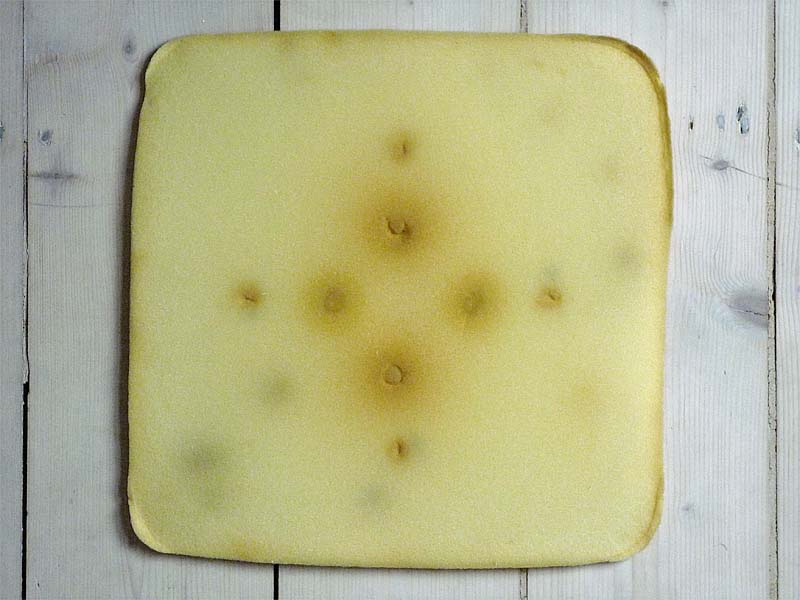
The foam, from a poor last reupholstery, has however these very interesting ghosted marks of the rivets and base holes which I am going to formalise and take back into the reworked pad.


The flipped base, showing how it interlocks with the frame. The orange wooden pieces in the top image are placed to north-south-mirror this attribute.


The previous vinyl, a vivid, sheeny mustard with a piece of found rawhide leather. Leather we will use but I'm thinking of retaining the vinyl in some respect. I like the idea of interchangeable permutations; possible with the unlocking mechanism and apertures.


Sally found this stool and we both recall the same from childhood. Hers had a plum vinyl top, mine a turquoise. I guess they were rife in 1975.

01/09/2010

The Red House


A couple of Sundays ago we visited The Red House, William and Jane Morris' home of only five years. It was designed by Morris with architect Philip Webb in 1859. Recently acquired by the National Trust, having been somewhat restored by Ted and Doris Hollamby from the 1950s onwards.


Never visited Kelmscott Manor, which would appear to be more as-was and more representative of his textiles. But the Red House had a lack of assumption that we appreciated. It felt a home. But also something askew in its atmosphere, perhaps because they had to leave for financial reasons; perhaps because of its contemporaneity with Jane's ongoing affair with Rossetti. Or that's whimsy. And I really don't want to be whimsical about Morris. Too much of that already, in the laminated tablecloths and Laura Ashleyisms to take away as souvenir from anywhere with anything to do with WM.


Been discussing him with Adrian Holme (Adrian is a constant source of inspiration; read his blog here).  WM is viewed sentimentally and also is seen to have romanticised the working class and the nature of craft. But in a context now where he is cited by, for example,Rollo Press, there is something to be understood about the way the technological cycle has returned to and now facilitating small volume, close-to-hand work. A foresight.


"To own the means of production is the only way to gain back pleasure in work, and this, in return, is considered as a prerequisite for the production of (applied) art and beauty." 


Certainly there is rigour in the junction points between holistically designed components of the House. An intensity that belies any mediated idea of Morris-lite. The weight of the hand. First hand. The objects, the conjunctions, the decisions are too vital.


31/08/2010

Peas and Poppies and Progress


Sally has been stitching the Pea Stool. It's nearly there. The thread certainly is describing the form and contour to a greater extent than before. The green pea leaf, a straight satin stitch, obviated the need for a yellow line to delineate the vein. I know this can be seen anywhere on any tablecloth but it's true to say that you only understand the 'why' after the 'do'.


Alongside this work, I've been developing a new plywood box work to be shown at Partners & Spade in New York, with a variant too in the upcoming show at Direktorenhaus in Berlin. An edition, Anomalous Buttons, will appear for Poundshop at the Shoreditch Festival. Just contributed a piece on my collecting ethic for the next It's Nice That publication, out on October 1st. And developing some limited run sticking-packing tape designs with Chandelier Creative, again in NY. Images of each when it seems prudent to do so.