04/02/2013

Secondment, Progress


In the throes of studio work, preparing 'Secondment', opening at Beginnings NYC on 21 February. More documentation, detail soon.

08/12/2012

03/12/2012


Worrying Something Into Shape


A junction point, with the need to establish some logic for a larger set of works in fabric. Here in this space, I'm hovering too much over each sentence — each postable image — and enjoying blurted thoughts published elsewhere with a 130 character cap. 

With a new body of work, the chance presents itself to grow a new arm – or flex an unused muscle. In this case, a different kind of mark made. I do not buy the thought that a measured line is less expressive. So this is not to find something more 'authentic' or 'characterful'. It's simply a self-adjustment. A different rhythm — some disturbance — across the surface of what is something edging towards pattern.

These are natively digital drawings and I do feel the tick to give them another texture which has more physical key. But they are what they are, even if I wince a bit, posting them. Because they are a means to an end, with the translation to appliqué, embroidery and print to come.

They have some quality I have felt when pinching clay. Worrying something into shape. Graphic hesitancy. That I do want to carry through into fabric. In tension with something more measured at the conjoint between the wobble of these marks and the templated stability of a support – be that a frame, a chair.

01/12/2012

05/11/2012

Something to say at St. Bride

I am speaking this Friday 9 November at St. Bride Library, for the one-day conference Letterpress: Something to Say. Co-ordinated by Catherine Dixon and Rose Gridneff.

It's coming at a time where my working systems across bookwork, stitched bag and chair, wall object and drawing are by-products of basically the same system (analogous to letterpress). In the end I do want an entropic slip out of the system for each output – and thinking hard about how this can happen.

03/10/2012

Pressed up to the page


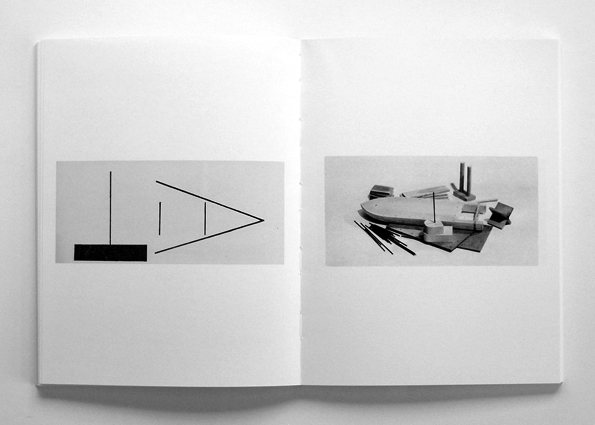
Four projects have come to a head at more or less the same time, hence the post silence. This — seen here in sequence and entirety (albeit with the spreads split) — a two-colour bookwork in edition of 300 for Container Corps of Portland, Oregon– in their 'Summer Sigs' series of publications by invited artists. The only stipulations were size (8.5" x 5.5"), page number (16), binding (saddle-stitch) and the inking (black, plus a chosen spot colour).

A number of influences behind the work. I was taken by the format. Harking back to the Make Do Type work for the New York Times, the benefits to working with imperial units have become apparent, really because of the fit to type measurement. This, in the knowledge that I will soon be making some letterpress work on an offset proofing machine, to feed an upcoming talk at St. Brides in November.

So the first move was to implement a square grid that would tally with the 8.5" x 5.5" page. Therefore, a 51 x 33 pica grid. Then, the notion of a book-object, with a system to hold moveable, concrete components. I am wary of the pegboard cliché but could see no other way as simple-stupidly flexible enough in this instance, to do what was intended.

This spread in sequence, from Quentin Fiore and Marshall McLuhan's The Medium is the Massage (1967) (via), has been an important one for use in my teaching of bookwork–based projects. The possibility of reader's thumb pressing and puncturing the epidermal page. In either direction. On another page, McLuhan speaks of "information being brushed up against information". So I was interested in squeezing the photopictured compositions up against the undersurface of the page, making the mediating skin as 'thin' as possible, under the reader's thumb. 

I had heard the erudite Sam Winston talk a couple of years ago, about his piece Pencil Drawing, being photographed under a large camera-scanner, for minimum distortion across the surface of his original. In the absence of such kit, I built the spreads on plywood 'pages' (with bleed), then scanned layer by layer, to brush each part up against the scanner glass and therefore the point of focus. Then, a painstaking recompositing job onscreen, so that all was in focus. The result, oddly synthetic.


Daily inspirators Michael Dumontier and Joe Gilmore have both recently issued bookworks with a kind  of mute thingliness. A conversation between pages, without recourse to words. Above, Michael's Call Ampersand Response (2012), with Micah Lexier. 

Here, Joe's Void() (2012), a risographic, eponymous derivation of his peerless site.


Finally, a real find, from Printed Matter in NY, a couple of years ago. Stina Ekman's Gitter (1985); "an intuitive exploration into the number of sculptures contained within the cube 60 x 60 x 60".

I want to write more about the component-language of the new bookwork and particularly its role as a pattern planner. Also the forms' inflection, out of the now happening Jiggling Atoms physics project. Save for the next post.